“We have reached the point where the internet has become a challenge to society”
-Clay Shirky Video
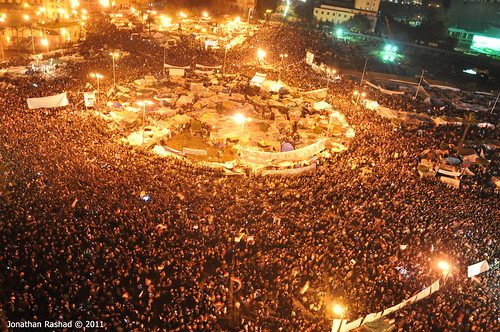 Large public demonstrations have occurred in the last year throughout North Africa and the Middle East as a result in part by the organizational advantages provided by social networking systems. Vast conversations throughout the internet on social media sites such as Facebook, Twitter and YouTube have contributed to uprisings in Tunisia, Lybia, Egypt and Syria. These systems have allowed for conversations to begin and for large groups to organize substantial demonstrations. Social networking sites serve several purposes during such events as the demonstrations in Egypt. Most importantly, networking sites allow thousands of individuals to organize for physical protest, with minimal infrastructure and resources – impossible previously with traditional media. As the proliferation of technology and internet begins to access all corners of the world I anticipate an increase in social uprisings and revolution in unstable regions. In the words of one protestor, “It’s a rehearsal for a bigger thing,” she said. “Right now, we are just testing the power”- http://www.nytimes.com/2009/01/25/magazine/25bloggers-t.html
 Oppressive governments around the world will continue to restrict the media digested by their citizens. Social media is no exception, but by virtue of sheer volume – it is less resilient to organized censorship. In Egypt, President Hosni Mubarak broadcasted images of an empty Tahrir square while millions were protesting and documenting the events online. “Newspapers are monitored by the Ministry of Information and generally refrain from directly criticizing Mubarak. And so for young people in Egypt, Facebook, which allows users to speak freely to one another and encourages them to form groups, is irresistible as a platform not only for social interaction but also for dissent.” - http://www.nytimes.com/2011/04/23/opinion/23walker.html?_r=4 As technology continues to propagate throughout the world information and opinions are more readily exchanged and as a result social causes can gain inertia more rapidly. Dissent has been able to organize in cyberspace and is now manifesting physically.
 Another major component of social media during these uprisings was to serve as a historian. Bloggers have become journalists and the mobile phone camera has become as powerful as a crew from CNN or National Geographic. Users were creating artifacts of history and distributing them amongst the social networks, contributing to the dynamic record of events. The viral effect these small artifacts created were vast and able to traverse the globe instantly gaining international attention and response. “It added a second layer of discussion and brought a wider audience into what would have been a private exchange. And it gave the event an afterlife on the Web.” - http://www.time.com/time/business/article/0,8599,1902604,00.html#ixzz1P7AMRTAQ
Social media is beginning to serve as a voice for the voiceless in areas of political unrest. What we as society are realizing now is that these movements sparked online can possess real power and the ability to spawn globally significant events. While powerful, social media still has some time before it can overpower the multinational media super corporations. Hopefully in time, these online voices will find an increasing stage and more significant action in response. ”Although social media have been a critical tool for creating political openings, opposition groups need national outlets if durable institutional reforms are to take place in societies that have endured extraordinary manipulation and repression.”- http://www.nytimes.com/2011/04/23/opinion/23walker.html?_r=3

I am very intrigued to see how your project will turn out. I have no background in computer science and would have no idea how to put together such a project. Looking at the various "tweets" relating to these crisis will be very interesting. Which of these disasters were written about most and what kinds of things were written about them?
ReplyDeleteI would assume that here in America there will be more comments on the issues that hit close to home. Do you think people are inclined to act by reading through others twitter feed?
Its unfortunate that some governments restrict the use of social media as an outlet of social change. I agree that social media is powerful but is not yet in the position to overpower the multinational media corporations. Its easily monitored and shut down or banned. The quote you used from NY Times, "Although social media have been a critical tool for creating political openings, opposition groups need national outlets if durable institutional reforms are to take place in societies that have endured extraordinary manipulation and repression" is definitely something I agree with. However, I think even in our own society, social media is a great way to get a social movement's ideas out- it is not enough to sustain a sound and powerful movement. Social media allows for the meeting of minds, but is not tool for revolution.
ReplyDeleteSocial media gives people all over the world a sense of freedom of speech. Even when a government oppresses its people by shutting down the internet, people find a way to communicate. I thought your second picture did a good job capturing the scene in the Middle East and North Africa. Masses of people are rising up; groups are being formed on Facebook and secret hashtags are being used to remain hidden from the government. In other words, people will always find a way to communicate and take action to voice their opinion. In America the bill of rights includes a section that gives Americans the right to assemble. This means that the U.S. government can not interfere with peaceful protests. However, Kent state is a horrible example where the government blatantly broke constitutional law.
ReplyDelete